
Why is DAII™ so important when choosing a diamond? Within the same 4Cs, it helps identify the truly superior diamond.
Updated: Sep 25

When buying a diamond, most people begin by looking at the 4Cs: carat, color, clarity, and cut. But the 4Cs are only the starting point, not the complete picture. A diamond’s brilliance, balance, and overall value are also shaped by its proportions, angles, depth, cut precision, and optical performance. DAII™ brings these complex factors together into a single, easy-to-understand quality score, making it simpler to compare diamonds with confidence. The 4Cs help you narrow down your options. DAII™ helps you identify the diamond that truly stands above the rest.
Contents
1. What is DAII™ ?
DAII™, short for **Diamond Artificial Intelligence Index**, is RAGAZZA’s proprietary AI-powered diamond quality evaluation system. Rather than simply repeating the 4Cs or relying solely on the grades shown on a certificate, it analyzes 16 key diamond parameters to provide a more comprehensive assessment of a diamond’s overall quality, including:
Analysis Categories | DAII™ Data Inputs |
Core 4C Data | Color 、Clarity 、Cut |
Cut Precision | Polish、Symmetry |
Proportions & Optical Structure | Table、Depth、Crown Angle、Pavilion Angle、Crown Height、Pavilion Depth |
Visual & Structural Risks | Fluorescence、Girdle、Culet、Length-to-width Ratio |
Certification | Certificate System |
These factors collectively influence a diamond’s brilliance, fire, scintillation, visual stability, proportion balance, and overall quality. To learn more about the origin of DAII™, its scoring methodology, and grading scale, read our dedicated article : DAII™ Diamond Quality Index: From Tolkowsky’s Brilliant Cut Theory to Modern AI Quality Index
This article focuses on answering a more practical question: Why is DAII™ so important when choosing a diamond?

2. Why Can Diamonds with the Same 4Cs Still Differ in Quality?
The 4Cs are the universal language of diamond grading, but they do not tell the whole story. Color, Clarity, and Cut Grade are all grading ranges rather than precise values. For example, two diamonds may both be graded D Color, yet one may rank higher within the D range. Two VS1 diamonds may have inclusions in different locations, affecting their visual appearance. Likewise, two Excellent Cut diamonds may differ in proportion precision, even though both receive the same grade.
For this reason, grades such as D, VS1, and Excellent alone cannot fully determine which diamond is better. Many buyers focus on color, clarity, carat weight, or price, but the more important question is:
Given the same budget and similar specifications, which diamond offers better overall quality?
DAII™ was created to answer that question.

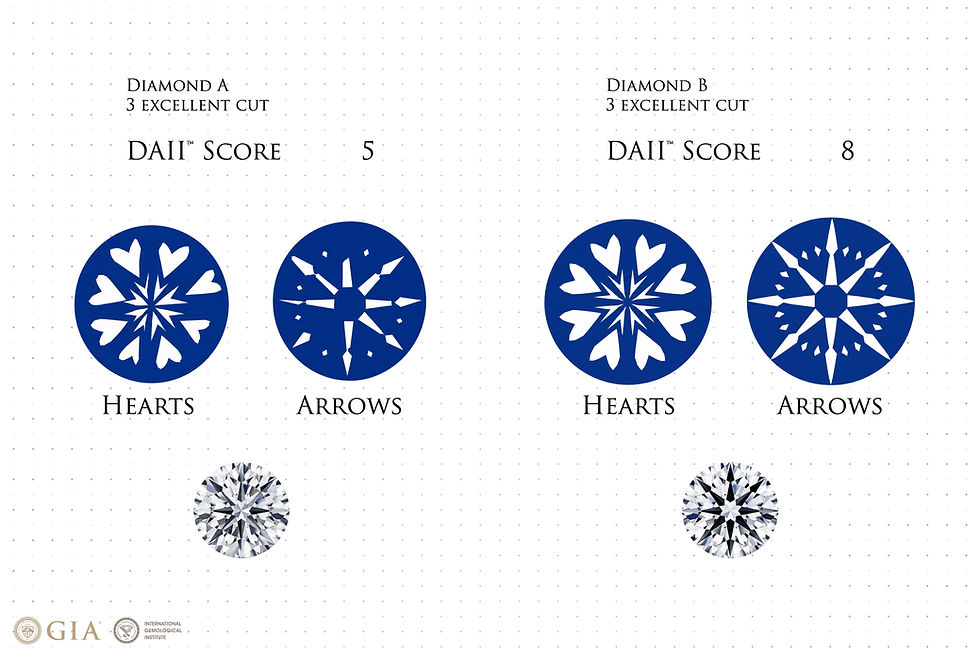
3. How Do You Choose the Better Diamond When Both Are D / VS1 / Excellent?
Imagine you're comparing two diamonds:
Diamond A : 1.00ct / D Color / VS1 / Excellent Cut
Diamond B : 1.00ct / D Color / VS1 / Excellent Cut
Based on the 4Cs alone, they appear almost identical. Most buyers would simply compare the price, diameter, or table size. However, these factors alone are not enough.
A diamond's overall quality is also influenced by its table, depth, crown angle, pavilion angle, crown height, pavilion depth, polish, symmetry, fluorescence, girdle, culet, and other proportion data.
For example:
Diamond A — DAII™ Score: 6.09
Diamond B — DAII™ Score: 8.33
Although both diamonds are graded D / VS1 / Excellent, Diamond B demonstrates a stronger overall quality profile according to the DAII™ model.
This is the core value of DAII™ - helping you identify the better diamond among those with the same 4C grades.
In many cases, diamonds with the same carat weight, color, clarity, and cut grade are priced very similarly. If one has a significantly higher DAII™ Score, you may be able to choose a diamond with better overall quality at nearly the same price. It's not about spending more—it's about choosing better.

4. A Diamond with Lower 4C Grades Can Still Be the Better Choice
Many people assume that a D Color diamond is always better than an E Color diamond, or that VVS1 is always superior to VS1. However, the 4Cs represent grading ranges, not a complete measure of overall quality.
When a diamond has better proportions, craftsmanship, and optical performance, it can achieve a higher overall quality despite having slightly lower 4C grades.
For example:
Diamond A : D Color / VS1 / Excellent - DAII™ Score: 6.81
Diamond B : E Color / VS1 / Excellent - DAII™ Score: 8.41
Based on the 4Cs alone, many people would choose Diamond A because D Color ranks higher than E Color. However, if Diamond B has more balanced proportions, superior cut precision, and a stronger optical structure, it can achieve a higher DAII™ Score and represent the better overall diamond.
Diamond | 4C | DAII™ Score | Traditional 4C Perspective | DAII™ Assessment |
A Diamond | D / VS1 / Excellent | 6.81 | Higher color grade, seemingly better. | The overall proportions and quality structure are not optimal. |
B Diamond | E / VS1 / Excellent | 8.41 | Lower in color, but seemingly a grade below. | Better overall quality structure and optical performance. |
A diamond with slightly lower 4C grades can sometimes outperform one with higher 4C grades in overall quality.
With DAII™, you may find a lower-priced diamond with slightly lower 4C grades, yet superior proportions and optical structure, resulting in greater brilliance and overall performance.
In other words, you don't always need to pay for higher 4C grades—what matters is choosing the diamond that truly performs better.

5. Finding the Best Diamond Within Your Budget
DAII™ is not just for high-budget buyers—it becomes even more valuable when your budget is fixed.
Simply set your budget, preferred carat range, color, clarity, and cut, then sort the results by DAII™ Score. Instead of comparing certificates alone, you'll instantly identify the highest-performing diamond within your price range.
DAII™ isn't about buying the most expensive diamond. It's about finding the diamond that delivers the best overall quality, brilliance, and value - within your budget.

6. Finding the Best of the Best Among Top 4C Diamonds
Even diamonds graded D / FL / 3EX / None are not all equal. While these grades represent the highest certification standards, they do not guarantee identical proportions or optical performance.
Differences in table, depth, crown and pavilion angles, crown height, pavilion depth, girdle, and overall proportions can still result in different DAII™ Scores.
Simply filter for D Color / FL Clarity / 3EX / None Fluorescence, then sort by DAII™ Score. Instead of choosing a diamond that only appears perfect on paper, you'll identify the true Best of the Best.

7. Understanding Your Diamond with DAII™
DAII™ is valuable not only before a purchase, but also after. While a diamond's 4Cs and GIA or IGI certificate describe its individual characteristics, they don't reveal its overall standing.
DAII™ score bands are 9.00+ (Collector), 7.00–8.99 (Premium), 5.00–6.99 (Standard), and below 5.00 (Basic). Product grades also require the relevant reports and selection checks. RAGAZZA’s inventory snapshot on 4 September 2026 contained 110,143 scored lab-grown round diamonds; one reached DAII™ 9.00+ (0.00091%). Three later September snapshots were also below 0.01%.
Rather than simply knowing your diamond's 4C grades, DAII™ helps you understand its overall quality, rarity, and position within the market.
8. Before and After DAII™: A Better Way to Choose Diamonds
How to Choose a Diamond | Traditional Diamond Selection | DAII™ Diamond Selection |
Step 1 | Set Your Budget | Set Your Budget |
Step 2 | Filter by 4Cs | Filter by 4Cs |
Step 3 | Compare Prices | Sort by DAII™ Score |
Final Step | Choose the Lower-Priced Diamond with Similar 4C Grades | Choose the Highest-Quality Diamond Within Your Budget |
Key Question | Which Diamond Is More Affordable? | Which Diamond Is Truly Better? |
Result | Buy the Most Affordable Diamond Within the Same Grade | Choose the Diamond That Delivers Greater Quality, Brilliance, and Value Within Your Budget |
Traditional diamond selection may seem logical, but identical 4C grades do not always mean identical quality. You may simply end up with the lower-priced diamond within the same grade, rather than the best-performing one within your budget.
DAII™ goes beyond the 4Cs by evaluating a diamond's overall quality structure, helping you move beyond buying the cheaper diamond to choosing the one that is truly better.

9. Frequently Asked Questions
Does DAII™ replace the 4Cs?
No. The 4Cs remain the foundation of diamond evaluation. DAII™ builds upon them by assessing proportions, cut precision, optical structure, fluorescence, and certificate credibility to provide a more complete quality assessment.
Why can two diamonds with the same D / VS1 / Excellent grades have different DAII™ Scores?
Because identical 4C grades do not guarantee identical quality. Differences in proportions, angles, polish, symmetry, fluorescence, and optical structure can significantly affect overall performance.
Can a diamond with lower 4C grades outperform one with higher 4C grades?
Yes. A diamond with slightly lower 4C grades but a higher DAII™ Score may deliver better overall quality, brilliance, and value than one with higher 4C grades but weaker proportions and optical performance.
Does a higher DAII™ Score always mean greater brilliance?
A higher DAII™ Score generally indicates stronger proportions and optical performance, though the visual appearance of a diamond may also vary depending on lighting, viewing conditions, and personal preference.
Is DAII™ only for high-budget buyers?
No. DAII™ is especially valuable when your budget is limited, helping you identify the highest-performing diamond within your price range.
Does a higher DAII™ Score always mean a better purchase?
When comparing diamonds of similar price, carat weight, and 4C grades, a higher DAII™ Score generally indicates a stronger overall quality. Final selection should also reflect your design preferences and personal priorities.
Does the DAII™ Score determine a diamond's price?
No. The DAII™ Score measures overall quality, not price. Diamond pricing is still influenced by the 4Cs, carat weight, certification, market supply, and design. DAII™ simply helps you identify the diamond with the stronger overall quality.
10. Conclusion: Filter with the 4Cs. Decide with DAII™.
The 4Cs are the foundation of diamond selection—but they are not the complete answer. Diamonds with identical 4C grades can differ in overall quality, while a diamond with slightly lower 4C grades may outperform another through superior proportions and optical performance.
DAII™ helps you identify the diamond with the strongest overall quality among diamonds with similar budgets, comparable specifications, or the same 4C grades.
It doesn't simply add another score—it gives you greater clarity and confidence in choosing the right diamond.
Filter with the 4Cs. Decide with DAII™.
Original content by RAGAZZA Diamond. All rights reserved. No unauthorized reproduction or use.

Visit RAGAZZA for a one-on-one consultation with our experts to discover the quality of lab-grown diamonds.
Click Here for locations and bookings.
