
Lab-Grown Gemstones: A Complete Guide to Types, Colours and Materials
Updated: 2 days ago
Ruby red, emerald green, deep sapphire blue and the changing colours of alexandrite all have laboratory-grown counterparts. The world of lab-grown gemstones also includes diamond, spinel, amethyst and opal. Some are established jewellery materials; others appear mainly through specialist suppliers, collectors or published research.
The most useful starting point is the material itself. One blue stone might be lab-grown sapphire and another lab-grown spinel, each with its own composition, lustre and durability. The gemstone species establishes the material's basic character; colour, cutting and setting shape how it appears in a finished jewel.

Figure 1. Colours and cuts of different lab-grown gemstones. Generated illustration.
Natural and lab-grown comparisons are generated illustrations of similar colour ranges. Origin requires professional identification.
Contents
1 The range of lab-grown gemstones
In gemmology, synthetic gemstones are manufactured materials with essentially the same chemical composition and structural characteristics as their natural counterparts. 'Laboratory-grown' and 'laboratory-created' describe this manufactured origin. Crystalline gems grow with a particular atomic arrangement; materials such as opal form differently and need to be considered separately.[1][2]
Mineral families provide a useful way to organise the range. Ruby and sapphire both belong to corundum, while emerald and aquamarine belong to beryl. This shows the relationships between jewellery names without treating every colour as an entirely different mineral.
Family or material | Documented lab-grown or synthetic examples | What to look for in jewellery |
|---|---|---|
Diamond | Colourless and near-colourless diamonds; various coloured diamonds | Established supply; read growth origin and treatment separately |
Corundum | Ruby; blue and other sapphires; star varieties | Broad colour range; processes and individual quality vary |
Beryl | Emerald; blue, red, yellow and pink materials | Emerald supply is established; confirm identity and availability for other colours |
Chrysoberyl | Alexandrite and other chrysoberyl colours | Genuine lab-grown alexandrite exists; other colour-change materials can imitate it |
Spinel | Colourless, blue, red and other colours | Sold as spinel and also used to imitate other gems |
Quartz | Rock crystal, amethyst, citrine, ametrine and others | Distinguish grown crystals from treated natural quartz |
Opal | Synthetic opal with play-of-colour and other appearances | Composition, polymers and assembly affect the correct description |
Less common synthetic materials | Forsterite, synthetic turquoise, synthetic malachite and others | Published examples do not imply widespread retail availability |
This guide covers jewellery materials and examples documented in published identification research. Scientists can produce far more minerals than a typical jeweller offers, so successful synthesis and a dependable supply of suitable jewellery-quality sizes are different achievements. That distinction matters particularly for less common materials.

Figure 2. Lab-grown gemstone appearances: A emerald; B aquamarine-like blue beryl colour; C amethyst; D alexandrite colour; E blue spinel; F opal. Generated illustration.

Figure 3. Lab-grown corundum: A ruby; B blue sapphire; C pink sapphire; D yellow sapphire. Generated illustration.
2 Lab-grown diamonds
Colourless and coloured lab-grown diamonds

Figure 4. Natural and lab-grown diamonds in colourless, yellow, pink and blue colour ranges. Generated illustration.
Lab-grown diamonds are diamond crystals made from carbon. The main jewellery production methods are high pressure, high temperature (HPHT) and chemical vapour deposition (CVD). HPHT uses high-temperature, high-pressure equipment to grow diamond on a seed; CVD supplies carbon from gases inside a reaction chamber. Each has its own equipment and process requirements, and other lab-grown gemstones use different growth methods.[1]
Alongside colourless and near-colourless diamonds, the market offers yellow, pink, blue and other coloured lab-grown diamonds. Their colours can arise from impurities or defects controlled during growth, and may also involve post-growth treatment. The colour name, growth origin and treatment history describe different aspects of the stone.
Diamond's high refractive index, dispersion and hardness support its distinctive brightness, contrasting flashes and fire. Coloured gems have their own optical characters: choosing lab-grown ruby or emerald means choosing a different material and colour expression. Explore the journey from seed to finished stone in How Are Lab-Grown Diamonds Made?
3 Lab-grown ruby and sapphires
Lab-grown ruby

Figure 5. Natural ruby and lab-grown ruby in a comparable red colour range. Generated illustration.
Ruby is red corundum, principally aluminium oxide, with chromium as an important colouring element. Lab-grown ruby is also corundum and can range from pinkish red to vivid and deeper reds. Flame fusion, flux and hydrothermal methods have all been used to grow ruby. GIA identification cases document the growth features and chemistry of hydrothermal synthetic ruby.[3]
Different processes produce different growth patterns, inclusions and crystal conditions. Finished stones also vary in tone, brightness and transparency. Look for face-up brightness, an even colour impression and the absence of large dark areas. Corundum has a Mohs hardness of 9 and good toughness, making it suitable for frequently worn jewellery such as rings; individual fractures and treatments can still affect care requirements.[4]
Blue sapphire

Figure 6. Natural sapphire and lab-grown sapphire in a comparable blue colour range. Generated illustration.
Sapphire is also corundum. In gemmological usage, gem-quality corundum other than ruby is generally described as sapphire, so the name includes more than blue. Lab-grown blue sapphire can be pale blue, richly saturated blue or violetish blue, depending on colouring elements, manufacturing conditions and cutting.[1]
The distribution of light and dark areas strongly affects the beauty of a blue stone. A deeply coloured sapphire that looks almost black face-up can wear very differently from a rich blue stone with lively facets. Observe it in daylight and indoor lighting to see whether the colour remains open and attractive.
Pink, yellow, orange and colourless sapphire

Figure 7. Lab-grown sapphires in pink, yellow, orange-pink, purple and colourless examples. Generated illustration.
Lab-grown corundum also appears in pink, yellow, orange, purple and colourless varieties. Pink sapphire and ruby meet at a colour-naming boundary. Orange-pink material may be sold with descriptions such as 'padparadscha colour'. A colour description, natural origin, rarity and a laboratory's naming opinion are separate pieces of information; a commercial colour name alone does not establish identity.[5]
Colourless lab-grown sapphire is often called white sapphire. It offers a clear, bright white gemstone appearance with the refraction and dispersion of corundum. Pink, yellow and orange corundum can provide a jewellery design's main colour or serve as coordinated accent stones.
Star ruby and star sapphire

Figure 8. Natural and lab-grown star ruby and star sapphire, showing cabochon shapes and six-ray stars. Generated illustration.
Lab-grown corundum can also display a star. Suitably aligned fine inclusions, combined with cabochon cutting, create intersecting light bands under a concentrated light source. The clarity and position of the star, and how it moves as the stone turns, are important visual features. This differs from the flashes of colour produced by a faceted gemstone.[1]
4 Lab-grown emerald and other beryl
Lab-grown emerald
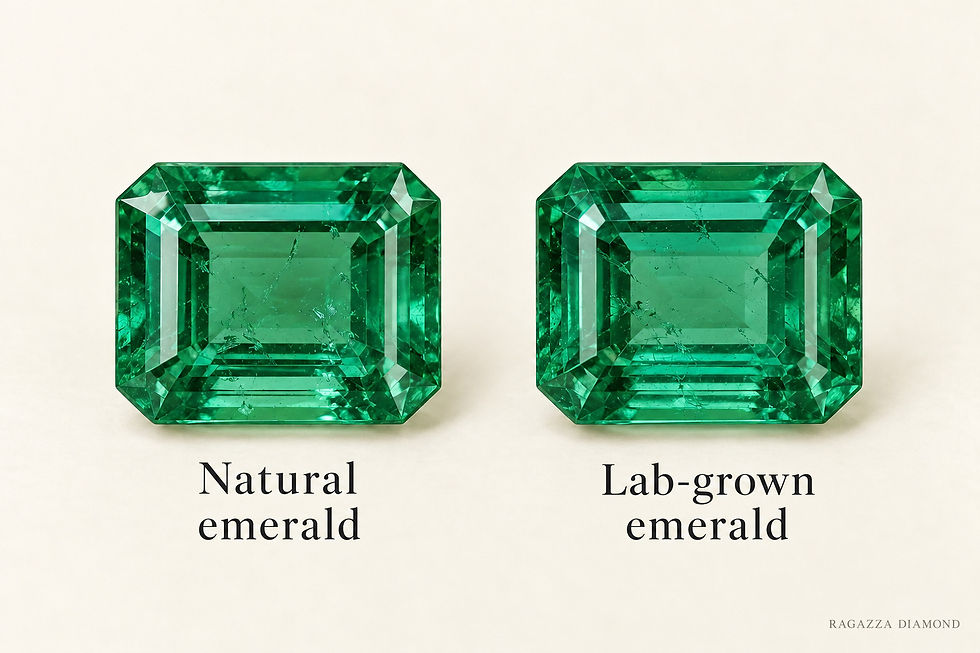
Figure 9. Natural emerald and lab-grown emerald in a comparable green colour range. Generated illustration.
Emerald belongs to beryl, a beryllium aluminium silicate mineral. Its green colour is commonly associated with chromium and vanadium. Hydrothermal and flux methods are important ways of producing lab-grown emerald crystals with the characteristics of emerald.[2][6]
These emeralds can contain different inclusions and growth features, with bluish green, more pure green and lighter or deeper appearances. Consider colour, transparency and cutting together: a large pale 'window' or dark area can interrupt the green impression. Natural and lab-grown emerald have different origins, but fractures and treatments matter for wearing either. Emerald has a Mohs hardness of approximately 7.5–8 and still needs protection from impact and sudden temperature changes.[7]
Aquamarine and other blue lab-grown beryl

Figure 10. Two blue lab-grown beryl colour examples; the material name should be checked against composition and identification. Generated illustration.
Natural aquamarine is blue to greenish blue beryl. Blue synthetic beryl has also been studied and produced as a jewellery material. An important distinction is that blue beryl can have different colour mechanisms, so every manufactured blue beryl should not automatically be described as a direct equivalent of ordinary natural aquamarine. GIA has compared the chemistry and spectra of natural aquamarine, Maxixe-type beryl and hydrothermal synthetic blue beryl.[8]
For a soft blue appearance, consider the balance of blue and green, saturation and the brightness of the cut. Read the identification report's material name alongside the seller's colour description.
Red, yellow and pink lab-grown beryl

Figure 11. Red, yellow and pink lab-grown beryl colour examples. Generated illustration.
Hydrothermal synthetic red beryl has been documented in growth research and faceted samples. It is a different mineral from ruby, despite sharing a red colour. The rarity of natural red beryl does not automatically transfer to the synthetic version's value.[9]
Yellow, pink and other synthetic beryl colours are also documented. Some use colouring-element combinations that differ from familiar natural varieties. Descriptions such as 'pink synthetic beryl' and sales names such as 'lab-grown morganite' therefore require confirmation of the actual composition and identification. With less common materials, knowing exactly what the stone is matters more than a familiar-sounding name.[10]
5 Lab-grown alexandrite and other chrysoberyl
Lab-grown alexandrite

Figure 12. Natural and lab-grown alexandrite colour-change examples under daylight-type and warm lighting. Generated illustration.
Alexandrite is the colour-change variety of chrysoberyl. Under suitable different light sources, its appearance can shift from green or bluish green towards red or purplish red. Genuine lab-grown alexandrite is chrysoberyl. Flux, pulling and floating-zone growth methods have been used to produce it, making this unusual lighting-dependent effect available in jewellery.[11]
The spectrum of each light source, viewing direction and cutting all affect the result. A practical approach is to observe the same stone under daylight-type and warm incandescent lighting, recording the light sources used. Photographs show appearances under particular conditions; the actual stone should also be examined.
Colour-change corundum and spinel are also used to imitate alexandrite. They can have interesting colour-change effects of their own, while remaining different materials. A report identifying synthetic corundum establishes that identity even if the sales description says 'alexandrite colour'.[1]
Other colours and optical effects

Figure 13. Green and yellow lab-grown chrysoberyl, with a cat's-eye effect example. Generated illustration.
Synthetic chrysoberyl extends beyond typical alexandrite. Research records vanadium-bearing green synthetic chrysoberyl and synthetic materials with cat's-eye or star effects. Some green material does not display the characteristic green-to-red change and is best described by its actual mineral identity and optical behaviour.[12][13]
Chrysoberyl is the mineral name; alexandrite is its colour-change variety. Understanding that relationship makes product information easier to read and avoids assigning an identity from a colour photograph alone.
6 Lab-grown spinel and quartz
Lab-grown spinel

Figure 14. Colourless, blue, red, pink and purple lab-grown spinel. Generated illustration.
Spinel is another oxide gemstone, typically magnesium aluminium oxide. Synthetic spinel includes colourless, blue, red, pink and purple material, produced by methods including flame fusion and flux growth. Chemical proportions can differ between processes, which identification also takes into account.[14]
Spinel illustrates two roles that can coexist. Sold under its own name, a manufactured stone is synthetic spinel. Used to imitate aquamarine, a blue synthetic spinel is also an aquamarine simulant. 'Synthetic' describes its manufactured material identity, while 'simulant' describes what it is being used to resemble.
Lab-grown rock crystal, amethyst and citrine

Figure 15. Lab-grown rock crystal, amethyst and citrine. Generated illustration.
Quartz is principally silicon dioxide. Laboratory-grown quartz has an established industrial background. Transparent colourless material is rock crystal, purple material can be lab-grown amethyst, and GIA also explicitly records synthetic citrine.[15][16]
Quartz colours may also involve irradiation or heating after growth. For example, citrine produced by heating natural amethyst remains treated quartz of natural origin. A laboratory-grown crystal has a manufactured origin. Origin and subsequent treatment should be described separately.[16]
Ametrine, smoky quartz and pink quartz

Figure 16. Purple and yellow zones in lab-grown ametrine, alongside smoky and pink lab-grown quartz. Generated illustration.
Synthetic ametrine contains purple and yellow regions in the same crystal and has been the subject of dedicated identification research. The cutter's positioning of those regions directly affects the finished two-colour composition.[17]
Smoky and pink synthetic quartz are also recorded in research or the market, with differences in colour origin and transparency. Transparent pink synthetic quartz, for example, need not have the hazy appearance associated with much natural rose quartz. Assess the colour and cutting, then confirm the material and treatment information.[18]
7 Synthetic opal and less common materials
Synthetic opal

Figure 17. Natural opal and synthetic opal play-of-colour appearances. Generated illustration.
Opal is admired for its shifting play-of-colour. Unlike the single-crystal gems discussed above, this effect involves an ordered arrangement of tiny silica spheres. Manufactured material can also reproduce the relevant structure and visual effect. Synthetic opal has a long development history, including white-body, dark-body and other appearances.[19]
Read the composition information: some materials contain polymers or are impregnated, while doublets and triplets combine different layers. Synthetic opal, imitation opal and assembled opal communicate different identities. Alongside colour and its distribution, jewellery use must take account of heat, solvents and the appropriate cleaning method.[19][20]
Synthetic forsterite and olivine

Figure 18. Green synthetic olivine and bluish violet synthetic forsterite examples. Generated illustration.
Forsterite is the magnesium end member of the olivine series, with the typical composition Mg₂SiO₄. Facetable synthetic forsterite and olivine have been produced, with some research connected to laser materials. Gemmological literature also records bluish violet synthetic forsterite used to imitate tanzanite.[21][22]
A manufactured crystal may therefore be grown for more than reproducing its natural counterpart. Its colour can lead to a different commercial role. A description such as 'lab-grown tanzanite' alone would not adequately identify a stone that is actually synthetic forsterite.
Synthetic turquoise, malachite and related materials

Figure 19. Colour and pattern examples for synthetic turquoise and synthetic malachite. Generated illustration.
Turquoise and malachite have also been the subject of synthesis research or manufacture, but their ordinary jewellery-market supply differs from that of lab-grown ruby and sapphire. Dyed minerals, reconstituted powders, resin mixtures and other imitations also occur, so appearance alone cannot establish composition.[1][23]
These less common materials are best understood through individual samples, manufacturing information and identification results. Their inclusion here shows the breadth of manufactured gem materials. Availability in suitable jewellery sizes and qualities still depends on the particular supply.
8 Moissanite and other manufactured jewellery materials
The broader range of manufactured jewellery materials includes crystals that should not be described as lab-grown diamond or as a particular lab-grown coloured gemstone. They have their own chemical identities and can also serve as simulants because of a similar appearance.[20]

Figure 20. Faceted appearances of moissanite, CZ, YAG, GGG, synthetic rutile and strontium titanate. Generated illustration.
Material | Identity | Typical role |
|---|---|---|
Synthetic moissanite | Silicon carbide, SiC | A jewellery gemstone; also a diamond simulant |
Cubic zirconia, CZ | Cubic zirconium oxide | Colourless and coloured simulants; different from natural zircon |
YAG | Yttrium aluminium garnet, Y₃Al₅O₁₂ | Optical and laser crystals; also faceted for jewellery |
GGG | Gadolinium gallium garnet, Gd₃Ga₅O₁₂ | Industrial crystals; also used as a diamond simulant |
Synthetic rutile | Titanium dioxide, TiO₂ | Faceted material with strong dispersion |
Strontium titanate | SrTiO₃ | Historically used as a highly dispersive diamond simulant |
Moissanite is silicon carbide; lab-grown diamond is carbon in the diamond structure. Although YAG and GGG include 'garnet' in their full names, they are not the natural red garnet or tsavorite familiar in jewellery. Full names and composition are more informative than broad sales terms such as 'man-made gem' or 'high-carbon diamond'.[20]
Glass, resin and assembled materials can also offer appealing jewellery appearances, but generally fall outside the grown mineral crystals discussed earlier. Cultured pearls form inside pearl-producing molluscs and belong within the biological context of pearl formation, even though people participate in their production.
9 Choosing a gemstone for your jewellery
How growth methods affect the material
The principal methods follow several different routes. Flame fusion melts feed material and crystallises it; pulling grows a crystal from a seed in a melt; flux growth dissolves components in a heated medium; hydrothermal growth uses hot, pressurised aqueous solutions. Diamond has its own important HPHT and CVD production systems.[2]
Equipment, growth rate, available sizes and identifying features vary with the method. Two lab-grown rubies may therefore involve different manufacturing costs and finished quality. For the wearer, growth information provides useful background, while the individual stone's colour, cutting and condition remain central.
Start with colour and optical character
Corundum is a starting point for rich reds and blues; emerald offers green colour and the layered reflections of step cuts. Suitable beryl or quartz varieties offer softer colours, while alexandrite, star corundum and opal provide changing or directional optical effects.
Jewellery design adds further requirements. Earrings need two stones that work together in size and colour, while a multi-stone necklace or bracelet needs visual continuity across the set. Laboratory growth can make suitable quantities and sizes more accessible for some materials, but a harmonious match still requires individual selection.
At RAGAZZA, we consider how the gemstone works within the whole jewel: the centre stone's colour, the coordination of accents, and the way metal and setting complement the gems. Explore our gemstone jewellery and read each design's material details to understand the available choices.
Then consider durability and disclosure
A frequently worn ring faces different conditions from a pendant that receives fewer knocks. Hardness describes scratch resistance; toughness, cleavage, fractures and treatments also affect impact resistance and cleaning. Laboratory origin does not turn emerald into corundum or give opal diamond's resistance to abrasion.[4][7]
Product information should identify the gemstone, its natural or manufactured origin, known treatments and care requirements. Where further confirmation is needed, specialist laboratories combine microscopy, spectroscopy and other analyses according to the sample. Coloured-stone reports often focus on identity, origin and treatment; the diamond D-to-Z and clarity systems do not apply universally to every gem.[24]
10 Questions and answers
Q1. What is the difference between a lab-grown gem and a simulant?
A: Lab-grown emerald is manufactured emerald material. Green glass used to imitate emerald is an emerald simulant. A lab-grown spinel can also imitate another gemstone, so the clearest description states both the actual material and its manufactured origin.
Q2. Is every pink gemstone a pink lab-grown diamond?
A: Pink diamond, pink sapphire, pink spinel and pink quartz may share a colour family while being different materials. Their refraction, dispersion, hardness and appearance in jewellery differ. Establish the species before comparing the colours you prefer.
Q3. Are lab-grown gemstones always inclusion-free?
A: Growth can leave seeds, growth patterns, flux residues and other inclusions. The features vary by process and sample. What matters for jewellery is whether they affect appearance or durability, together with clear information about the stone's origin.[2]
Q4. Why are some lab-grown gemstones still relatively expensive?
A: Some methods take considerable time and equipment, with additional costs from usable crystal yield, cutting losses and matching requirements. Cutting, colour and jewellery craftsmanship also vary. One fixed percentage of a natural stone's price cannot describe every material and quality.[2]
Q5. Does every natural gemstone have an established lab-grown version?
A: No. Successfully synthesising a mineral does not mean large, facetable jewellery material can be produced economically with dependable availability. Less common 'lab-grown' gemstone names should be checked against composition, manufacturing information and identification results.
11 References
Sources checked on 24 October 2026. Historical studies establish materials and manufacturing methods; they do not imply that the samples remain in continuous commercial supply today. Generated images illustrate appearances and colour ranges.


