
Old Mine Cut Lab-Grown Diamonds: A Collector’s Guide
The light of antique faceting in jewellery with a character of its own

If you already know round diamonds and modern cushions, start your next piece with the kind of light you enjoy. The broad facets of an old mine cut produce distinct flashes as the diamond turns. Its high crown and soft corners give you different details to discover from the front and the side.
Cutters also use this antique faceting style on lab-grown diamonds. Look for the terms Old Mine Cut or Old Mine Cushion Cut. In an engraved ring, an east–west pendant or a pair of cluster drops, the cut itself can bring out your taste for vintage jewellery.
Contents
The light and character of an old mine cut
Old mine cuts appear in jewellery from the eighteenth and nineteenth centuries. Cutters worked by hand with the shape of natural rough, producing softened square outlines, small tables, high crowns and visible culets. Modern lab-grown diamonds can recreate this structure in near-square or more elongated outlines.
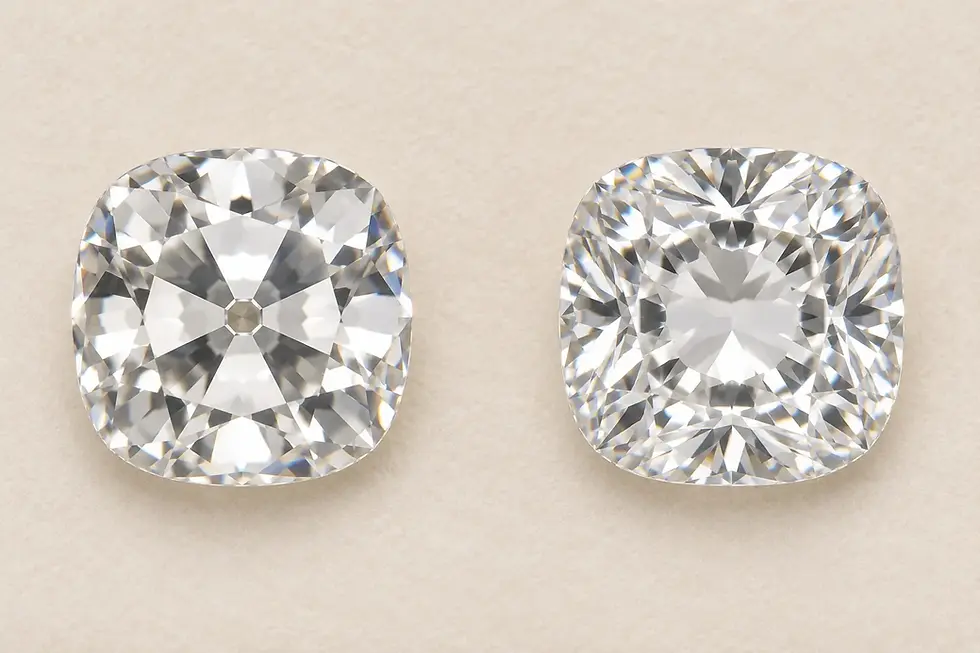
Shorter lower-half facets often make the reflections from the main facets look broader. Turn the diamond by a window or under warm evening light and watch the flashes alternate. Looking through the centre of the table may reveal the culet as a small polygon. These details reward a closer look and give even a simple piece of jewellery a distinctive character.

Cut structure and history GIA’s guide to old mine cut diamonds
How common are old mine cuts among lab-grown cushions?
In our 9 November 2026 supply list, roughly one to two of every 100 lab-grown cushion diamonds were old mine cushions.
Category | Diamonds | Share of lab-grown cushions |
All lab-grown cushions | 25,485 | 100% |
Old mine cushions | 395 | 1.5% |
This is a snapshot of that day’s supply, deduplicated by grading laboratory and report number. The old mine cushion count uses the list’s antique cushion classification.
Supply of lab-grown and natural old mine cuts
Lab-grown supply depends on cutting and stocking. Cutters plan facets around the dimensions and shape of the grown rough. Chemical vapour deposition (CVD) often produces plate-like crystals, while high pressure, high temperature (HPHT) growth commonly produces cuboctahedral crystals. A high crown and deep pavilion at a given width require sufficient rough thickness. Thinner rough can mean a smaller face-up outline or a shallower design.
Cutters also consider demand for this kind of light. Nearly 97% of the cushion diamonds in this snapshot were listed as standard square or elongated cushions. A high crown, broad facets and a visible culet appeal to a more specific taste. A particular elongated outline, culet size or matched pair further narrows the selection.
Antique natural diamonds have a different supply history. The old mine cut followed the shape of common octahedral rough and helped retain weight. Today, supply of original antique cuts depends on jewellery coming back to market and on its condition. Some historic stones have been recut. Newly cut natural old mine diamonds, like lab-grown ones, still require suitable rough and planning around the same proportions.
Rough and diamond growth GIA on how lab-grown diamonds are made
Further reading from RAGAZZA How quickly can lab-grown diamonds grow?
Old mine and other vintage cuts
If you like broad flashes in a round outline, consider an Old European Cut. If you prefer a jewel that sits close to the skin with a softer, more transparent glow, the Rose Cut has a very different profile.
Figure 4. Old mine cut with a rounded square outline and broad facets (illustration). Figure 5. Old European cut with a round outline and radial facets (illustration). Figure 6. Rose cut with triangular facets meeting at the top of a dome (illustration).
Figure 4. Old mine cut with a rounded square outline and broad facets (illustration).
Figure 5. Old European cut with a round outline and radial facets (illustration).
Figure 6. Rose cut with triangular facets meeting at the top of a dome (illustration).
Compare the three outlines and facet patterns, then look at their profiles in the diagram.

Cut | Outline and structure | Appearance when worn |
Old Mine Cut | Rounded square or elongated cushion, small table, high crown and visible culet | Broad flashes and distinct changes from light to shade |
Old European Cut | Round outline, small table, higher crown and visible culet | Broad flashes with a more regular radial pattern |
Rose Cut | Several outlines, commonly with a flat base and a dome of triangular facets | Soft, translucent glow and a low profile in flat-based forms |
What to look for in a loose diamond
Start face-up, then turn the same diamond to its side. Compare candidates in the same light and from a similar distance, then check their actual millimetre measurements on the report.
Face-up view: culet, corners and reflections
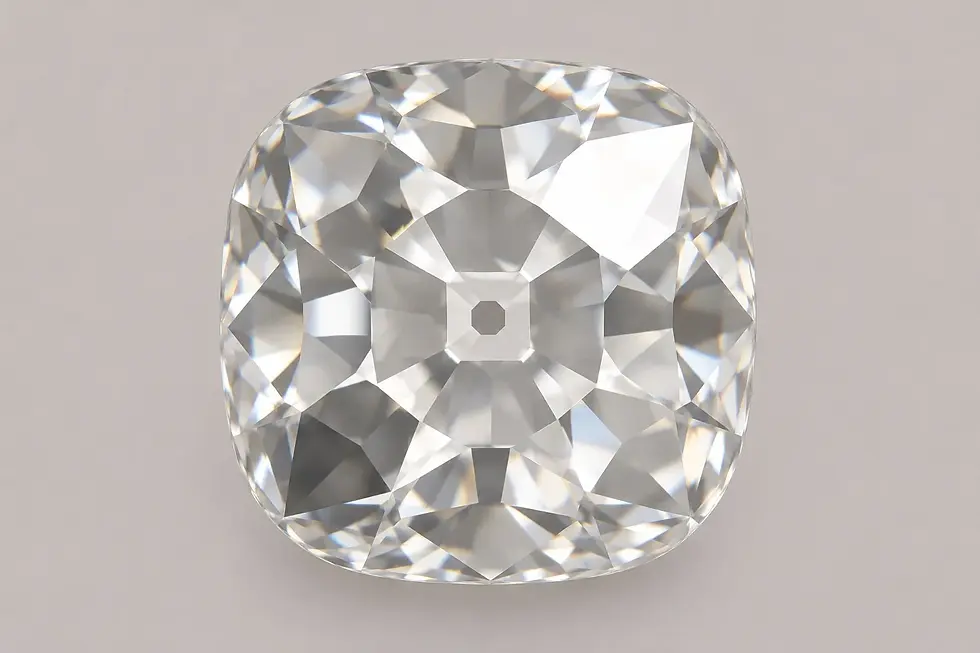
Find the culet in the centre, then look at its shape and position. Follow the curve of the four corners and decide whether you prefer a squarer or longer outline. In a slow-turning video, watch whether bright areas move towards the corners and whether any area stays dark across several angles.
Profile: crown height, girdle and pavilion depth

From the side, check how high the table sits and how far the pavilion extends below the girdle. Cushions of equal weight can have different face-up dimensions. Compare length, width and depth, and ask your consultant to check whether any areas of the girdle are especially thin.
Setting: how the metal supports the diamond

The claws need to follow the rounded corners and girdle. A deeper pavilion also needs more room beneath it. For pendants or drops, compare a side view of the loose diamond with the setting drawing to check the points of support and how the piece will hang.
Further reading Cut grading for fancy-shaped diamonds
Old mine cut jewellery designs
The rounded corners and high crown of an old mine cut make it a good candidate for choosing the diamond first and designing the setting around it. These pairs show how orientation, metalwork and the setting change the look of the same cutting style.
Rings
Figure 11. Petal-shaped setting and engraved shoulders (illustration). Figure 12. Art Deco-inspired east–west ring (illustration).
Figure 11. Petal-shaped setting and engraved shoulders (illustration). A silver-coloured petal setting follows the outline of the stone, paired with engraved gold shoulders for an antique metalwork detail.
Figure 12. Art Deco-inspired east–west ring (illustration). An elongated cushion sits east–west inside a milgrain bezel. Stepped shoulders and rectangular side stones give the ring its geometric lines.
Pendants
Figure 13. East–west gold bezel pendant (illustration). Figure 14. Vertical claw-set pendant with an openwork bail (illustration).
Figure 13. East–west gold bezel pendant (illustration). A narrow gold bezel traces the elongated cushion. Worn close to the collarbone, the east–west orientation draws attention to the broad flashes.
Figure 14. Vertical claw-set pendant with an openwork bail (illustration). The long cushion sits vertically. Fine claws leave more of the edge visible, and an openwork bail leads the eye down to the diamond.
Drop earrings
Figure 15. Vintage-inspired flower cluster drops (illustration). Figure 16. Gold huggie drops with cushion bezels (illustration).
Figure 15. Vintage-inspired flower cluster drops (illustration). Small rounds form petals around a near-square cushion. A hinged link allows the drop to move and catch light at different angles.
Figure 16. Gold huggie drops with cushion bezels (illustration). Each gold huggie carries a bezel-set old mine cushion. A short link gives the earrings movement and keeps the soft corners in view.
If you would like to bring a particular outline, setting or metalwork detail into your own piece, explore RAGAZZA bespoke jewellery.
Historic examples Christie’s Victorian pendant brooch · Sotheby’s Van Cleef & Arpels flower earrings
Loose diamond prices and sourcing
At RAGAZZA, we price lab-grown old mine cuts on the same basis as lab-grown cushion diamonds of the same weight. These are reference prices for three common carat weights. Settings and jewellery manufacture are priced separately.
Reference quality. All three prices are based on lab-grown diamonds with an IGI report, D–F colour and VS2 clarity or higher. We assess the facets, culet and play of light of each old mine cut individually.
Weight | HKD | TWD (approx.) | MYR (approx.) |
1 carat | HK$2,500 | NT$10,500 | RM1,300 |
2 carats | HK$5,750 | NT$24,160 | RM2,990 |
3 carats | HK$9,000 | NT$37,810 | RM4,680 |
Prices checked on 12 November 2026. TWD and MYR are approximate conversions using that day’s quotation-sheet rates, rounded to the nearest ten.
For weights over 3 carats, another specific weight or a matched pair, contact a RAGAZZA consultant for availability and pricing. To compare loose diamonds first, browse our loose diamond selection.
Choosing a diamond for your next piece
If you already own familiar cuts, an old mine diamond offers another way to choose a piece by the light it gives and how you want to wear it. Find the culet and flashes you want to keep looking at, then let the shape of that diamond guide the setting and metalwork.
Frequently asked questions
Q1 Can a lab-grown old mine cut have a grading report?
A Yes. A report can confirm the lab-grown origin and dimensions. If the shape is listed as cushion, use a video or in-person view to check the facet pattern and culet.
Q2 Does an old mine cut need a large culet?
A Culet size and shape vary. Turn the diamond and compare the centre with the surrounding reflections to see which appearance you prefer.
Q3 How can I distinguish an old mine cut from a modern cushion?
A Start with the face-up reflections. Old mine cuts often show larger patches of light and shade and a visible culet. Then compare the table, crown and pavilion from the side.
Q4 Will two 2-carat diamonds look the same size when worn?
A Carat measures weight. For visible size, compare length, width and depth. A deeper stone can look smaller face-up, while an elongated cushion draws the eye along its long axis.
Q5 Can I request a square or elongated cushion?
A Yes. Share your target carat weight and approximate length-to-width ratio, or send a reference image. Our consultant can compare individual diamonds by dimensions and video.
Q6 What makes a well-matched pair for drop earrings?
A Compare face-up dimensions, corner shapes and colour side by side under the same light. Then look at the visibility of each culet and the flashes when the diamonds turn. Similar visual proportions make the pair feel balanced when worn.
Q7 Can I commission a piece based on the illustrated designs?
A Yes. Bring the design you like to a consultant. We can adapt the setting to the chosen diamond’s outline, girdle and depth, then discuss metal, side stones and how you plan to wear it.


