
Emerald Cut Diamond Buying Guide: How to Select the Ideal Stone
Emerald cut diamonds are celebrated for their elegant, sleek, and vintage silhouettes. Unlike the intense fire and scintillation sought in round brilliant diamonds, the emerald cut prioritizes clarity, clean lines, and an architectural beauty characterized by its "hall of mirrors" light play. Because of these unique traits, the selection logic for an emerald cut differs significantly from that of a round diamond. While round diamonds can rely on their sparkle to mask certain characteristics, the emerald cut belongs to the "step-cut" family. Its larger facets and open structure act like a window, making inclusions, color tints, and proportion flaws much more apparent to the eye.
In short, the emerald cut is not the easiest shape to select. However, when chosen with precision, it offers a sophisticated, understated, and timeless aesthetic that is truly high-end.
Table of Contents

1.Why the Emerald Cut Stands Out
The emerald cut is a classic "step-cut," featuring facets arranged in parallel rows that resemble a staircase. Unlike round brilliant diamonds, which use numerous tiny triangular facets to create intense sparkle, the emerald cut is designed for a completely different visual experience.
This unique structure creates a "Hall of Mirrors" effect. Instead of fragmented flashes of light, it produces broad, layered reflections that feel deep and tranquil. The appeal of an emerald cut lies not in mere "shimmer," but in its clean rectangular silhouette, elongated lines, and the sophisticated transparency of its large table.
However, this understated elegance comes with a trade-off. Because the facets are open and the table is large, inclusions and color tints are not easily hidden by sparkle. Any internal flaws—such as dark spots or cloudiness—are more visible than in other shapes. Ultimately, the emerald cut is the ideal choice for those who value clarity, proportion, and minimalist aesthetics over raw brilliance.

2.Emerald Cut Diamond: Advanced Selection Guide for Clarity and Color
The core beauty of an Emerald Cut lies in the transparency created by its "step-cut." Due to its large table and long facets, any inclusions or color tints are fully exposed. Therefore, when selecting a diamond, one cannot rely solely on certificate grades; it is essential to understand the subtle logic of how specifications interact.
Core Highlights & Case Analysis
Clarity is the Key to Transparency: The emerald cut has a very low tolerance for inclusions. As shown in the top-left image, a diamond reaching the highest specifications (D, FL, Ideal) features a flawless table, perfectly showcasing the signature "Hall of Mirrors" effect.
Cut Proportions Determine Visual Tension: Specifications are not absolute, as cut quality can bridge small gaps in clarity. Comparing the top-right image (D, VVS1, VG/G) with the bottom-left (D, VS1, 2EX), although the VVS1 has higher clarity, its inferior cut proportions compared to the 2EX stone result in less fire and balance than the VS1. This proves that even with premium clarity, a diamond loses its soul without precise cut support.
Warning on the Low-Spec Trap: As seen in the bottom-right image (G, SI1, 2EX/VG), these specifications require extreme caution. SI1 inclusions are clearly visible under the broad table, and because the "Hall of Mirrors" effect reflects light in layers, a G color will appear more noticeably yellow than it would in a round diamond, diminishing the high-end feel the emerald cut should possess.
Considerations for Consumers:
Clarity: A grade of VS1 or higher is recommended as a safe starting point. If choosing VS2 or below, you must confirm that inclusions are not in the center of the table or the reflection zones of the long facets.
Color: D – E color is preferred for white gold settings to achieve an icy look; F – G color can be considered for yellow or rose gold settings.
Cut: Proportions, symmetry, and depth must be considered simultaneously to ensure even and balanced light reflection.
The core aesthetic of the Emerald Cut lies in its unique "step-cut" and "rectangular silhouette." Beyond clarity and color, the Length-to-Width Ratio is a key factor in determining visual style, as different ratios bestow the diamond with entirely different looks.
3.Mastering the Ratio: Shaping Your Ideal Silhouette
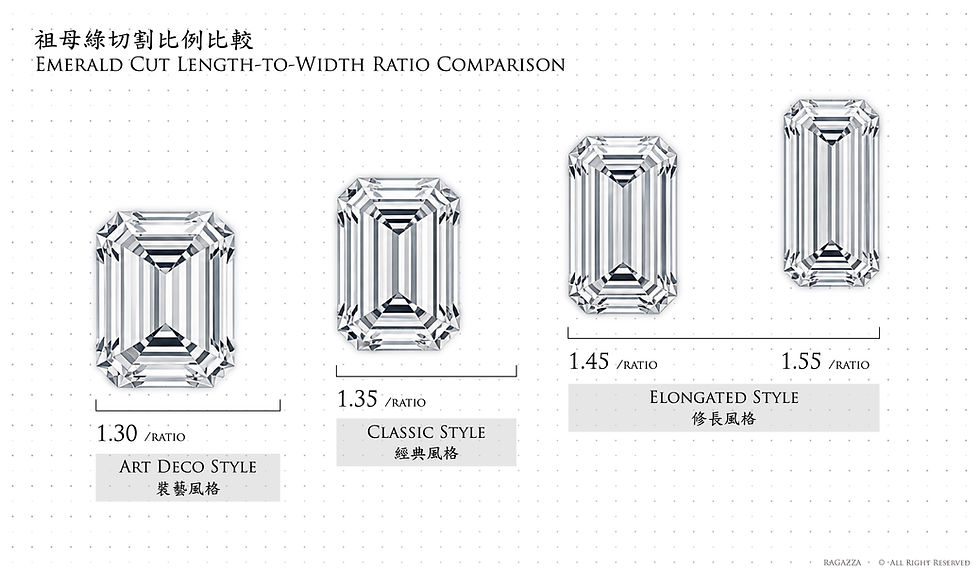
Length to width(Ratio) | Visual Effect | Style | Best For |
1.30 - 1.35 | Wider, more stable appearance | Vintage Art Deco | Those who prefer a strong presence and classic feel over an elongated look. |
1.35 - 1.45 | Balanced and moderately elongated | Classic & Elegant | The safest choice for most, ideal for a wide range of engagement ring designs. |
1.45 - 1.55 | Slender with strong visual extension | Elongated Elegance | Those who want to make their fingers look longer, though width balance is key. |
Key Buying Reminders
Ratio is not the only indicator: Even with the same ratio, factors like corner size, table percentage, depth, and symmetry all affect the final aesthetic.
Hand Synergy: While elongated proportions can visually lengthen the fingers, they must still harmonize with the specific ring setting and design.
Seeing is believing: Data is only the first step. We recommend using high-definition photos, videos, or an in-person viewing to make your final decision.
The beauty of an emerald cut diamond depends on multi-dimensional proportional details that cannot be fully captured by certificate data alone. RAGAZZA offers one-on-one diamond consultation services, where our specialists help you evaluate both specifications and physical condition to ensure the perfect selection for your needs.

4.Beyond the Certificate: Evaluating Cut Quality in Person
Diamond certificates are important, but for emerald cut diamonds, the certificate is not everything.
Round brilliant diamonds usually have a comprehensive cut grade, such as Excellent Cut; however, the emerald cut is a "Fancy Shape," and major grading reports typically do not provide a singular overall cut grade as they do for round diamonds.
In other words, a certificate can tell you the carat, color, clarity, polish, symmetry, table, depth, and measurements, but it cannot fully tell you if the emerald cut diamond is truly beautiful.
When selecting an emerald cut diamond, you must observe the following points:
1. Is the step-cut light and shadow orderly?
A good emerald cut diamond should display clear, organized step-like reflections. When you rotate the diamond, the light and shadow should alternate rhythmically rather than appearing chaotic, fragmented, or unbalanced. This neat "step" feel is the most captivating part of an emerald cut. If the facet alignment is poor, the diamond may lack a high-end look even if the certificate data seems good.
Is there a noticeable "windowing" effect?
One of the most critical issues to avoid in an emerald cut is the center area looking hollow like glass, commonly referred to as "windowing" or light leakage. A good emerald cut diamond should have transparency without looking "empty." Transparency means it is clean, bright, and deep; hollowness means light is not being reflected properly, causing the diamond to lose its vitality.
Are there overly large dark zones?
Emerald cut diamonds require contrast between light and dark to create mirror-like depth. However, if large areas of black appear, the diamond will look heavy and dull, losing its elegance. A premium emerald cut diamond should strike a balance between brightness and shadow. It can have depth, but it should not be consumed by dark zones.
Are the polish and symmetry of high quality?
Polish and Symmetry are especially vital for emerald cuts. Due to their simple lines and large facets, any skewed edges, unbalanced corners, or misaligned facets are much easier to see than in other shapes. Generally, it is recommended to choose diamonds with Excellent Polish and Symmetry. Symmetry, in particular, directly impacts the linear beauty of the emerald cut.
5.Carat Weight, Visual Size, and Setting Styles
Many buyers first ask, "How many carats is this?" But for emerald cut diamonds, carat weight is not the only priority. When actually worn on the hand, visual size and physical dimensions are equally important. Two diamonds that both weigh 1.50ct may appear different in size from the top view due to variations in depth. If a diamond is too deep, the weight may be concentrated at the bottom, making the surface dimensions look insufficient. Another stone with better proportions might appear more elongated and prominent despite having the same carat weight.
Therefore, when choosing, you should look at the actual length and width in millimeters in addition to the carat weight. For an emerald cut diamond, the face-up silhouette, proportions, and visual balance are often more important than simply chasing a higher carat count.
The setting style also affects the overall impact of an emerald cut diamond. A classic four-prong setting maximizes the display of the emerald cut's silhouette, making it ideal for those who prefer a minimalist and sleek style. This design highlights the diamond's natural lines, ensuring the center stone remains the visual focal point.

Three-Stone Setting : Offers a sense of luxury. Especially when paired with tapered baguettes or long baguette diamonds, it enhances overall proportions and flatters the lines of the finger.

Halo Setting : Can increase the visual size, but may also diminish the inherent minimalism of the emerald cut. To preserve the architectural beauty of the stone, the halo design must remain clean and delicate rather than overly complex.

Bezel Setting : Provides a more modern and secure feel, suitable for buyers who prioritize low-key style and practicality. However, a bezel setting can make the diamond appear more subdued, losing some of the transparency found in open settings.

Men’s Styles : Emphasize bold, minimalist lines. By using wide bands and flush mountings, the step-cut structure of the emerald diamond is transformed into a rational, architectural aesthetic. Adding subtle side diamonds to the band can introduce a touch of softness and nobility to the sturdy design, showcasing a gentlemanly balance of strength and refinement.
6.Choosing Between Natural and Lab-Grown Emerald Cut Diamonds
Both natural and lab-grown diamonds can produce stunning emerald cuts. The real difference lies not in the shape itself, but in your budget, values, and the purpose of your purchase. If you value rarity, traditional heritage, and the symbolic meaning of natural formation, a natural emerald cut diamond is the classic choice. Natural diamonds have higher market recognition and better align with the traditional expectations some buyers have for engagement rings.
If you prioritize visual impact, size, color, and clarity, lab-grown emerald cut diamonds are highly attractive. For the same budget, you can select a higher color grade, better clarity, or a larger carat weight. For a cut like the emerald, which emphasizes transparency, this provides a significant practical advantage.
However, whether you choose natural or lab-grown, you cannot rely solely on the certificate. The core of an emerald cut diamond remains its actual visual performance: whether the proportions are harmonious, the table is clean, the light and shadow are balanced, and the face-up appearance is bright.
7.Final Purchase Checklist: Key Points at a Glance
Before purchasing an emerald cut diamond, use the following criteria for a quick check:
Does the length-to-width ratio match your desired silhouette?
Is the ratio within the common, harmonious range of 1.30 to 1.50?
Is the clarity eye-clean?
Are inclusions kept away from the center table and obvious reflection zones?
Does the color complement the metal of the ring setting?
Is there any noticeable light leakage (windowing)?
Are there any overly large dark (dead) zones?
Are the step-cut facets orderly and well-layered?
Are the polish and symmetry at an "Excellent" level?
The ideal emerald cut diamond is not necessarily the one with the highest numbers on the certificate, but the one that is most balanced, cleanest, and best suits the wearer's temperament.
At RAGAZZA, when we select emerald cut diamonds, we look beyond carat, color, and clarity. We simultaneously evaluate proportions, light and shadow, table cleanliness, step-cut performance, and the overall effect of the diamond once set. For an emerald cut diamond, true beauty comes from total balance, not just a single number.

8.Frequently Asked Questions (FAQ)
Q1: Do emerald cut diamonds sparkle?
Yes, but they sparkle differently than round diamonds. The emerald cut is not known for intense "fire" or scintillation; instead, it features broad, layered flashes of light and mirror-like reflections. Its aesthetic is more understated and elegant rather than loudly brilliant.
Q2: Must I buy a VVS clarity for an emerald cut diamond?
Not necessarily. While VVS clarity is exceptionally clean, it isn't a requirement for everyone. For many buyers, a VS1 grade that is eye-clean with inclusions tucked away from prominent areas is a more practical choice. The real priority is whether the stone looks clean to the naked eye, rather than just chasing the highest grade on paper.
Q3: Which color grade is best for an emerald cut diamond?
If using white gold or platinum settings, D to F color is generally the safe range. D to E will appear icier, while F often offers a better value. If using yellow or rose gold settings, slightly warmer tones can blend in naturally, making the highest color grades less essential.
Q4: What is the best length-to-width ratio for an emerald cut?
The most common and harmonious ratios range from 1.30 to 1.50. For a classic rectangular look, consider 1.35 to 1.45. A wider ratio offers a vintage feel, while a higher ratio provides an elongated look. There is no single "correct" answer; it depends on your finger shape, ring design, and personal taste.
Q5: Do emerald cut diamonds look larger than round diamonds?
Not necessarily. Because of their elongated shape, emerald cuts can sometimes provide more finger coverage. however, if a diamond is cut too deep with the weight concentrated at the bottom, the face-up visual size may be smaller than expected. It is important to check both the carat weight and the actual millimeter dimensions.
Q6: Are emerald cut diamonds suitable for engagement rings?
Absolutely. Emerald cut diamonds possess a mature, clean, and classic temperament, making them ideal for those who love understated luxury, minimalist styles, and linear beauty. While not the flashiest choice, they are timeless and perfect for long-term daily wear.
Original content by RAGAZZA Diamond. All rights reserved. No unauthorized reproduction or use.

Welcome to the RAGAZZA Official Website to learn about our quality standards and collections.
To visit the official RAGAZZA website, Click Here

Visit RAGAZZA for a one-on-one consultation with our experts to discover the quality of lab-grown diamonds.
Click Here for locations and bookings.
